BEIJING (Realist English). China is carrying out large-scale construction of military infrastructure in the remote desert regions of the Xinjiang Uyghur Autonomous Region aimed at protecting its strategic nuclear forces. The findings are based on satellite imagery reviewed by Reuters.
According to security experts, the new facilities are designed to preserve China’s ability to launch a retaliatory nuclear strike even in the event of a massive first attack by the United States.
Satellite images reveal more than 80 sites that could be used by mobile missile launchers, air-defense systems, communications hubs, and electronic warfare units. The images also show the construction of bunkers, command centers, and communications infrastructure near silo-based intercontinental ballistic missile (ICBM) positions.
Analysts believe the project represents the most significant expansion of hardened infrastructure supporting China’s land-based nuclear forces in recent years.
“We can see infrastructure being built on a massive scale across thousands of square kilometers beyond the missile silo fields,” said Alexander Neill, an adjunct fellow at the Pacific Forum. According to him, the scale of construction indicates a substantial enhancement and diversification of China’s strategic nuclear capabilities.
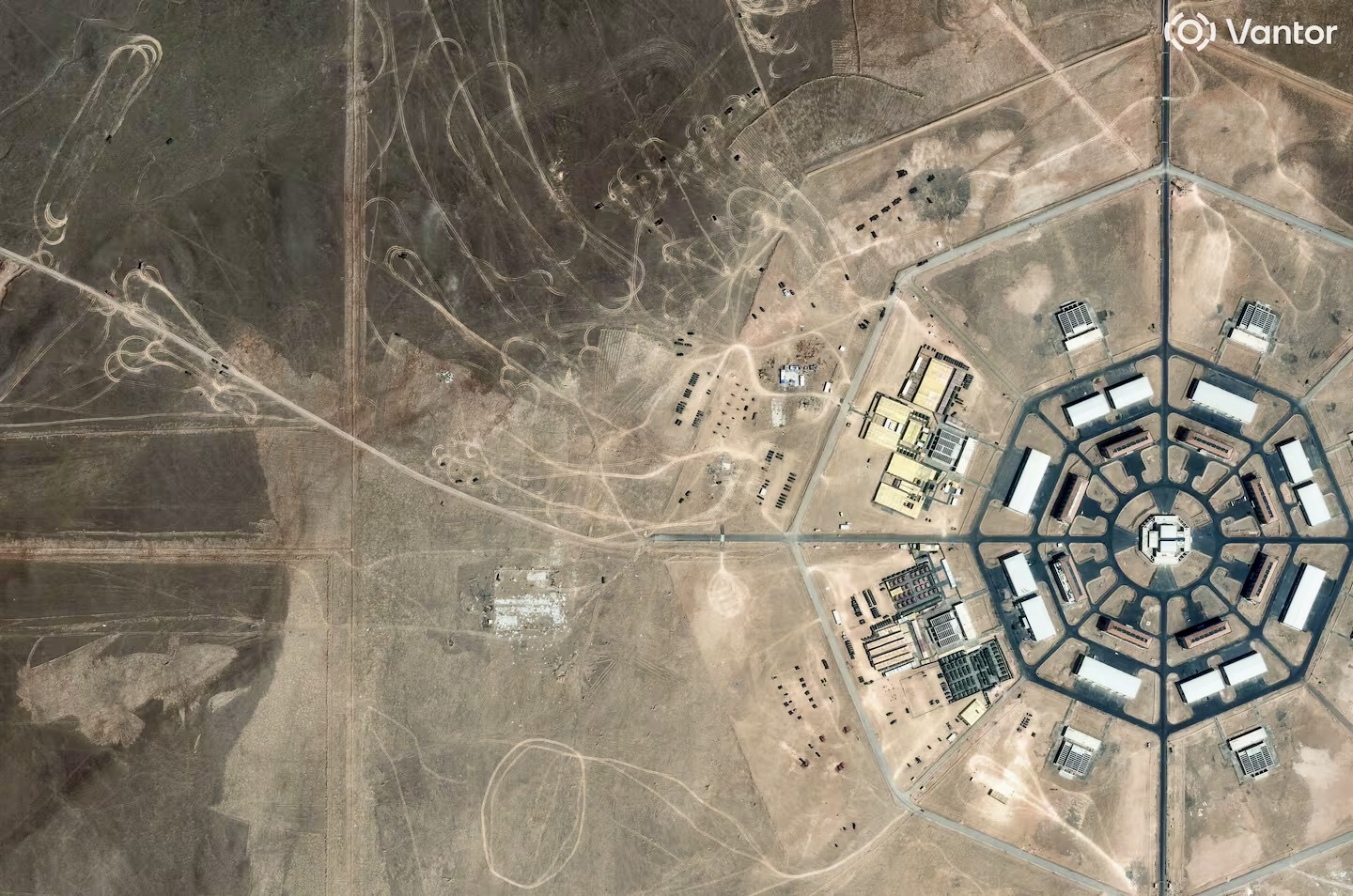
The new facilities are centered around two octagon-shaped military complexes built in eastern Xinjiang over the past six years. Both sites are located southwest of the Hami missile fields: one approximately 140 kilometers away and the other about 230 kilometers distant.
The imagery shows personnel housing, heavy-vehicle parking areas, fortified weapons depots, defensive structures, airfields, and railway terminals connected to strategic missile positions.
Military activity involving large units was observed around the northern complex in April and May 2026. Analysts also identified camouflaged positions carved into the desert terrain, some of them protected by air-defense missile batteries.
Five experts interviewed by Reuters agreed that the infrastructure could support China’s nuclear forces, while cautioning that many details remain unclear. In particular, it is unknown what specific weapons systems will be deployed at the new sites and whether some facilities are intended for the storage of nuclear warheads.
During a military parade in Beijing in September 2025, the People’s Liberation Army displayed both silo-based and road-mobile intercontinental ballistic missiles capable of carrying nuclear warheads.
According to Pentagon assessments, China continues to expand its nuclear arsenal faster than any other country in the world. Despite a slowdown in warhead production, Washington expects Beijing to possess approximately 1,000 nuclear warheads by 2030. U.S. estimates suggest that around 100 ICBMs may already be deployed across China’s three main missile fields.
China is also strengthening its missile early-warning system, which is based on the Huoyan-1 satellite constellation. According to U.S. military assessments, the system can detect the launch of an intercontinental ballistic missile within approximately 90 seconds and relay information to command authorities within three to four minutes.
Particular attention has been drawn to a network of roads and underground conduits extending from the octagonal complexes deep into the desert. These routes connect central facilities with numerous concrete launch pads situated among rocky outcrops and dried riverbeds.
Experts believe the pads could be used for mobile air-defense systems, electronic warfare assets, and road-mobile intercontinental ballistic missile launchers.
Hans Kristensen, director of the Nuclear Information Project at the Federation of American Scientists, noted that the scale of construction in such a harsh environment makes it difficult to rule out any potential military role for the facilities.
According to analysts, the underground conduits may contain fiber-optic communications lines designed to provide secure command and control of strategic forces.
A satellite or microwave communications facility is also under construction near the northern complex. Satellite dishes and two large towers are visible in the imagery.
“I’ve never seen anything quite like it. It’s an extraordinary effort,” Kristensen said.
Tong Zhao, a senior fellow at the Carnegie Endowment for International Peace, believes the new facilities may form part of China’s command, control, and communications architecture for its nuclear forces, while also supporting maintenance and storage operations associated with the Hami missile complex.
A third octagon-shaped installation located south of the former Lop Nur nuclear test site remains far less developed. Satellite imagery suggests it is being used as a training range, with damaged buildings and mock-ups of Western military aircraft visible on the ground.
According to analysts, the scope of the defensive infrastructure distinguishes China’s approach from those of the United States and Russia. Washington and Moscow traditionally rely on large numbers of missile silos, geographic isolation, and hardened construction, whereas Beijing appears to be building an extensive network of active defenses and mobile deployment positions.
Even veteran observers acknowledge that the scale of the project is unprecedented.