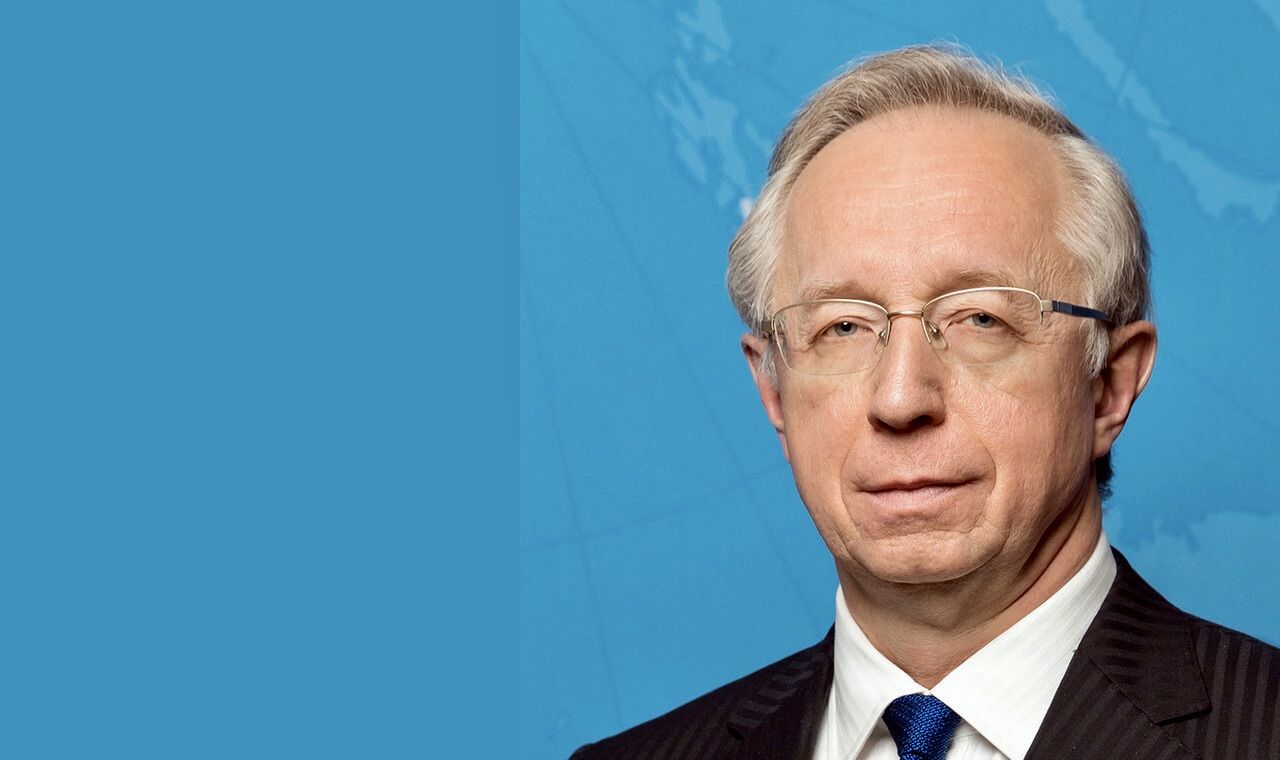
MOSCOW (Realist English). Russian Deputy Foreign Minister Mikhail Galuzin has given a wide-ranging interview to the TASS news agency, covering key aspects of Moscow’s foreign policy – from the Ukraine settlement to relations with Armenia, Georgia and Moldova.
The senior diplomat confirmed Russia’s readiness for a diplomatic solution to the conflict but stressed that Kyiv and its Western sponsors are not demonstrating the corresponding political will.
On the Ukraine settlement: ‘The ball is not in our court’
Galuzin drew attention to the contradictory rhetoric and actions of Washington. US Secretary of State Marco Rubio, he noted, speaks of the failure of “Anchorage” and the need to seek new ideas, yet simultaneously continues arms shipments to Kyiv.
“We are raising all these issues sharply in our ongoing contacts with Washington. For our part, while remaining committed to the goals of the special military operation set by Russia’s leadership, we are ready to implement them taking into account the Anchorage understandings,” the deputy minister said.
The diplomat stressed that a settlement is only possible with political will and concrete, legally binding security guarantees for Russia. At the same time, the daily attacks by the Armed Forces of Ukraine on civilian infrastructure, he said, indicate that Volodymyr Zelenskyy is not interested in peace.
“Continuing the conflict is for him and his clique the only way to stay in power and avoid responsibility for the criminal acts they have committed. Under these circumstances, we have no choice but to continue steadily resolving the tasks of demilitarisation and denazification of Ukraine by military means,” Galuzin concluded.
Istanbul and Geneva: stalled through no fault of Moscow
Speaking about the prospects of resuming talks in the Istanbul and Geneva formats, Galuzin reminded that it was the West that derailed the previous agreements.
“It is well known that the Istanbul format was wrecked in 2022 by then-British Prime Minister Boris Johnson, who called on Kyiv to ‘just fight’. The contacts in Istanbul, resumed in 2025 on the initiative of Russian President Vladimir Putin, were halted by Kyiv under the pretext of ‘a lack of progress’,” he said.
Russia’s principles, outlined by the president on 14 June 2024, remain unchanged. Moscow is open to constructive proposals that take into account its legitimate security interests.
On the cabinet reshuffle in Ukraine: ‘the sum does not change’
Commenting on the appointment of the new Commander-in-Chief of the Armed Forces of Ukraine, Mykhailo Drapatyi, Galuzin said the reshuffles were driven by Zelenskyy’s desire to retain power and control over the Western financial “feeding trough”.
“These current shuffles of functionaries in Kyiv will not affect either the internal situation in Ukraine or the course of the conflict,” the diplomat stressed.
He also drew attention to Drapatyi’s statements, which, according to him, claimed that the Russian nation “has no right to exist” and insulted residents of Donbas with obscene language. “Such outbursts once again prove the justification for the goals of denazifying Ukraine,” Galuzin added.
On Armenia: a referendum is the honest path
Galuzin confirmed that the EAEU countries expect Armenia to hold a national referendum on its membership in the union. A joint statement by the presidents of Russia, Belarus, Kazakhstan and Kyrgyzstan of 29 May speaks of the need for such a step “as soon as possible”.
“A great deal has indeed been said, but this adds no clarity at all. That is precisely why the leaders of Russia, Belarus, Kazakhstan and Kyrgyzstan declared the need to find out what the people of Armenia actually think on this matter,” the diplomat said.
He stressed that the question should be posed not in abstract form, but concretely: is Armenia ready to give up EAEU membership for the uncertain prospect of joining the EU?
“Because this formulation of the question would be the most honest towards the citizens of the Republic of Armenia themselves. And towards the other EAEU members too,” Galuzin added.
He also reminded that the issue of possible consequences of suspending the EAEU Treaty for Armenia will be discussed at the December meeting of the Supreme Eurasian Economic Council.
CSTO: withdrawal from participation does not remove obligations
Galuzin commented on Armenia’s non-payment of CSTO contributions. According to him, Yerevan’s refusal to participate in the organisation’s work does not mean its obligations to pay the national contribution cease.
“The CSTO Charter is an international treaty and must be conscientiously fulfilled by all its parties,” the diplomat stressed.
Any decisions on possible restrictive measures against Armenia fall under the prerogative of the CSTO Collective Security Council, whose next meeting will take place in Moscow on 11 November.
On Belarus: any provocation is an encroachment on the Union State
Galuzin warned that the risks of an armed provocation by Ukraine against Belarus are being taken into account by Moscow and Minsk. Aggressive statements from Kyiv, supported by the European Commission, are seen as an attempt to expand the geography of the conflict.
“Any attempts to destabilise the situation and provoke our ally will be regarded as an encroachment on the entire Union State,” he said.
Since March 2025, a Treaty on Security Guarantees between Russia and Belarus has been in force, establishing a clear mechanism for joint response. Within the unified defence space, the Joint Regional Grouping of Forces and the Unified Air Defence System are functioning.
On Moldova: violations of Russian diplomats’ rights will be answered
Galuzin condemned the actions of Chisinau, which, according to him, has lost even the appearance of independence and is blindly following Brussels’ directives, primarily directed against Russia.
“The practice of provocations against our embassy staff, Russian diplomatic couriers and officials began to be applied by Chisinau after the coming to power in the country of pro-Western anti-Russian forces in 2020–2021,” the diplomat recalled.
He stressed that all hostile actions will receive adequate responses in accordance with the principle of reciprocity.
On Georgia: economy grows, politics frozen
Galuzin noted significant progress in trade and economic cooperation with Georgia: one in four tourists in Georgia is from Russia, and the Russian market is the main one for Georgian exports.
“Despite the unprecedented external pressure on Tbilisi, the ultimatum demands to abandon interaction with our country have not had the effect the West was counting on,” he stressed.
However, political dialogue between the countries is absent. The reason, according to Galuzin, is Georgia’s unwillingness to engage in such contacts.
“It is hard for me to judge how this helps Georgia overcome various problems, but it is the decision of its authorities,” the deputy minister concluded.
Mikhail Galuzin reaffirmed Russia’s commitment to the goals of the special military operation and openness to diplomatic dialogue, but stressed that the ball is not on Moscow’s side.
The conflict with Ukraine remains at the centre of attention, and its settlement, in the Russian diplomat’s view, is possible only by addressing the root causes and obtaining reliable security guarantees.
The situation around Armenia, Georgia and Moldova remains tense, and Moscow’s position remains firm: cooperation is possible only if Russia’s interests and those of its allies are respected.