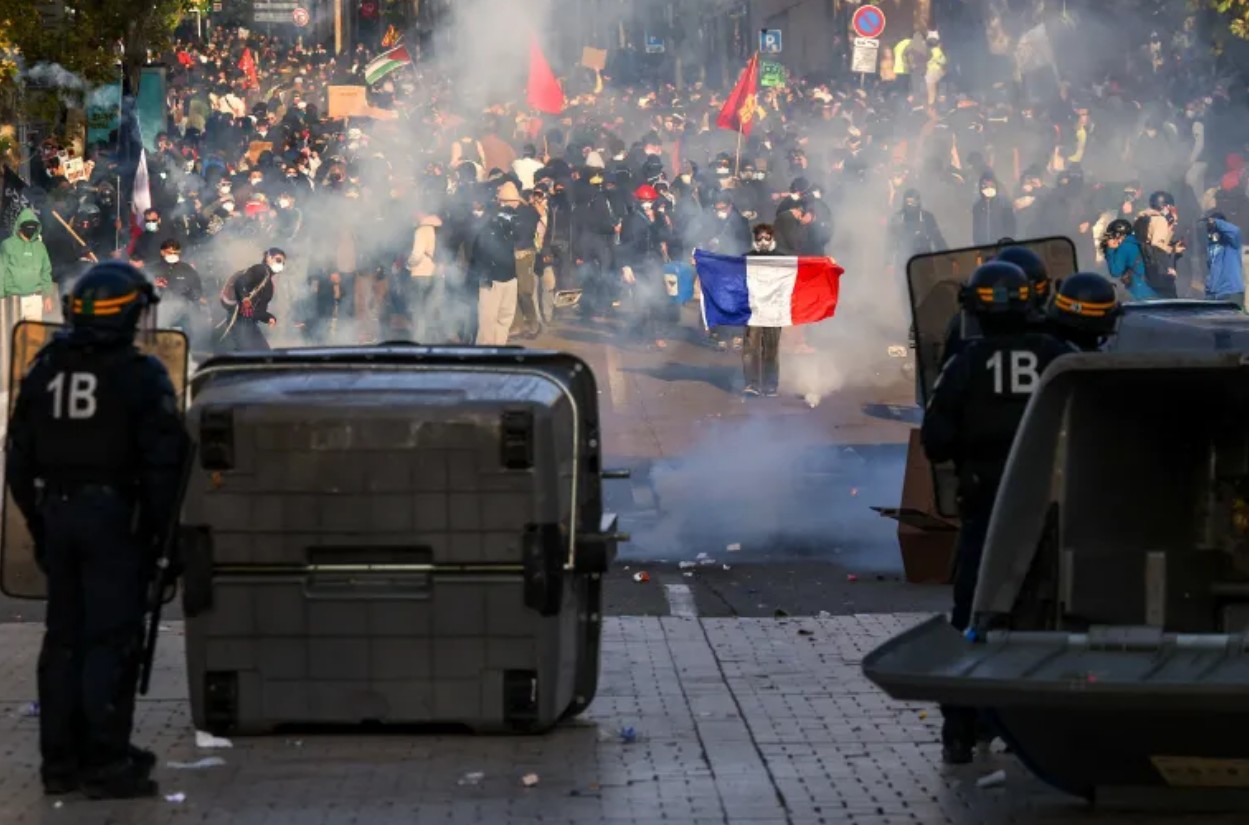
PARIS (Realist English). In the night of October 28, the French Senate passed the “casseurs-payeurs” (“rioters pay”) bill, establishing joint civil liability of protest participants for damage caused during unrest. After more than six hours of debate, the text was approved by 229 votes to 105. The bill, originally conceived as a response to the unrest after Paris Saint-Germain’s Champions League victory in May, gained new significance after the October 17 pogroms, when thousands of businesses across the country were damaged and looted.
What the bill provides
The key innovation is Article 1, which creates a regime of joint liability. The state will be able to demand compensation of up to €10,000 from each person who “intentionally participated” in a group that committed acts of vandalism, even if that person did not personally cause damage.
An amendment by the National Rally (RN) to raise the cap to €30,000 was rejected. In addition, Article 4 allows the seizure of part of social benefits — family allowances, housing aid (APL), and the active solidarity income (RSA) — to repay the debt. According to calculations by Communist Senator Fabien Gay, a household on RSA would need 14 years of monthly deductions to pay €10,000, and with a €30,000 cap — 44 years.
Positions of the parties
Interior Minister Laurent Nuñez insisted on the “urgency” of responding to the damage, stating: “We can no longer allow the vast majority of citizens to pay for a minority of vandals.” The right and center alliance, which holds a majority in the Senate, supported the text; far-right leader Marine Le Pen, the favorite in the 2027 presidential race, also spoke in favor.
The left opposition accused the authorities of an “authoritarian drift.” Communist Fabien Gay called the bill a “legal farce deliberately conflating protesters and rioters.” Green Mélanie Vogel pointed to “collective punishment” as a response to social demands. Socialists warned that seizing family allowances and APL would force members of the same family to answer for one person’s actions. Amnesty International urged lawmakers to reject the document, noting that it “will have a chilling effect on the freedom of peaceful assembly” and could “plunge already marginalized families into even greater poverty.”
Related bill
At the same time, the Senate approved a separate text allowing authorities to demand the prompt removal from social media of content calling for “insurrection or taking up arms against the state.” Platforms will be required to remove such content within 24 hours under threat of blocking or delisting.
What next
The bill now goes to the National Assembly, where political fragmentation and the weight of the left opposition could complicate its passage. Lawyers point to the risk of blocking in the Constitutional Council: the principle of personal responsibility for one’s own actions is one of the fundamental in French law, and joint liability for the actions of others may be seen as an excessive restriction on freedom of assembly.
The Senate’s adoption of the bill is not the final point but an intermediate stage. The Senate, dominated by the right alliance, traditionally supports tough measures, but the final say lies with the National Assembly and, likely, the Constitutional Council.
The very construct of “liability without guilt” — where presence in a crowd is equated with participation in a pogrom — goes beyond classical French law and creates a precedent that may be challenged. For unions and the left, this is a signal that the authorities are responding to social protests not with dialogue but with repressive legislation.
For the government, it is an attempt to demonstrate toughness ahead of the 2027 elections, where Le Pen already supports the text. The question is whether the bill will survive parliamentary and judicial filters — or remain a political gesture that never becomes law.