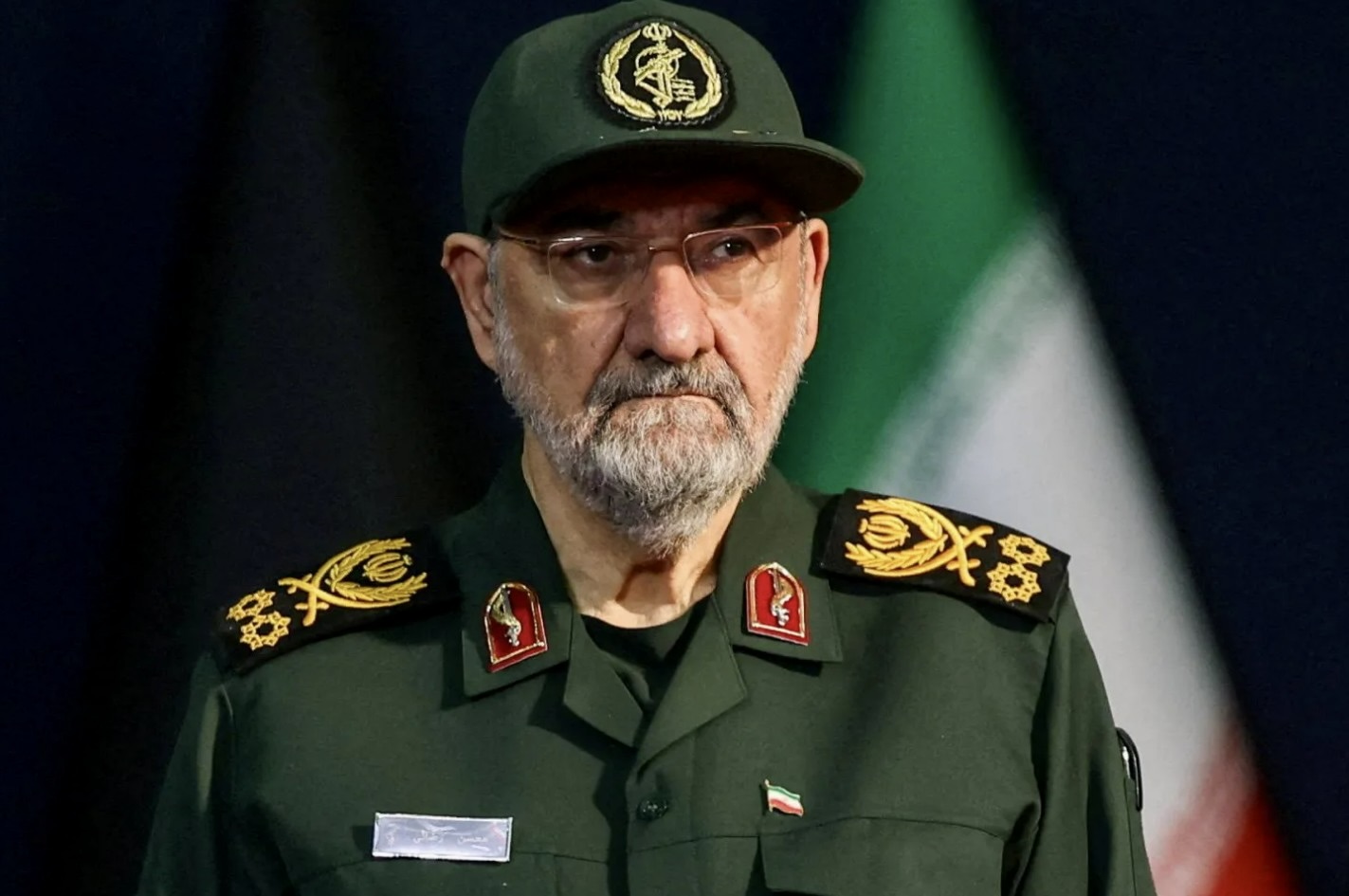
TEHRAN (Realist English). Iran’s Supreme National Security Council Secretary Mohsen Rezaei has warned neighbouring countries that participation in the US “economic war” against Tehran will be regarded as a hostile act, and that retaliatory measures will be “like an earthquake.”
If neighbors join US sanctions, according to Rezaei, “not a single drop of oil will leave the Persian Gulf and the Strait of Hormuz,” and alternative export routes will also be blocked.
Iranian President Masoud Pezeshkian has stated that the country is engaged in a “full‑scale economic, military and security war.” Donald Trump, for his part, has once again posted a map designating the Strait of Hormuz as “new US territory.”
Tehran’s ultimatum
On 22 August, Secretary of Iran’s Supreme National Security Council Mohsen Rezaei issued a stark warning to neighbouring states in an interview with state television:
“We declare to all surrounding countries: do not participate in America’s economic war, or we will consider you enemies.”
Rezaei stressed that Tehran does not seek to expand the conflict but would be forced to strike at the interests of any country that supports Washington’s economic pressure. If neighbors join the American campaign, Iran is prepared to go to extreme measures:
“Not a single drop of oil will leave the Persian Gulf and the Strait of Hormuz, and we will also strike other routes through which oil is exported.”
He also warned that any new move by US President Donald Trump against Iran would be met with “a response like an earthquake.”
Pezeshkian: ‘Full‑scale war’
On 23 August, Iranian President Masoud Pezeshkian stated that the country is in a “full‑scale economic, military and security war.” In a televised address, he stressed:
“The enemies assumed that through their pressure and actions they would make Iran collapse. Not only did this not happen, but the strength and unity of the Iranian nation have amazed the world.”
At the same time, the president acknowledged serious economic problems: “Of course, we are ashamed before the people that problems exist” – and promised that the government would continue to serve the nation. Pezeshkian also noted that Washington had wrongly predicted that Iran would become a “second Venezuela.”
Positions on the Strait of Hormuz
| Side | Position |
| US (Trump) | The strait is “new US territory”; the US has “full control” |
| Iran (Rezaei) | The strait is closed and will remain closed until the US “corrects its behaviour” |
Rezaei also stated that “Iran today is not the Iran that existed before the war,” and that the image of a “peaceful” United States has changed in the minds of young Iranians. He accused Israeli Prime Minister Benjamin Netanyahu of promising Trump that an economic blockade would force Tehran to surrender within two to three months.
Trump: map of ‘new US territory’
On 23 August, US President Donald Trump posted a map on his Truth Social platform designating the Strait of Hormuz as “NEW US TERRITORY.” Earlier, on 15 August, at a rally in New York, he declared:
“After we finish the defeat of Iran, which is suffering a very serious defeat – very soon I will declare the Strait of Hormuz the territory of the United States.”
Israeli strike on Syria
Simultaneously with the escalation around Iran, Israeli forces on 22 August carried out a drone strike on a vehicle in the village of Beit Jinn in southwestern Syria, on the western outskirts of Damascus. According to Syrian media, several civilians were wounded.
Syria’s Foreign Ministry condemned the attack, calling it “Israeli occupation aggression.” Jordan also condemned the strike. Israel, for its part, said the attack was directed against a militant who was in the “final stages” of planning attacks.
Chile closes embassy in Tehran
Amid the escalation, Chile announced it would close its embassy in Tehran by the end of August. In a statement, Chile’s Foreign Ministry said the decision was aimed at optimising diplomatic resources and protecting diplomats amid ongoing instability in the Middle East. Diplomatic relations between the countries are not being severed.
Escalation of rhetoric on all fronts
Rezaei’s ultimatum is a direct signal to the Gulf states, which find themselves facing a difficult choice between Washington’s pressure and Tehran’s threats. Iran is once again using the Strait of Hormuz – the strategic waterway through which a fifth of global oil trade passed before the conflict – as its main lever of pressure.
At the same time, Trump continues to escalate his rhetoric, posting a map of “new US territory,” while Iranian President Pezeshkian acknowledges that the country is in a “full‑scale war.”
The Israeli strike on Syria adds yet another front of tension, demonstrating that the conflict extends far beyond the US‑Iran confrontation.
The key question is whether regional states are willing to risk their economic interests to align with the US line – or whether they will prefer to maintain neutrality in the face of Iranian threats.
As Rezaei noted, “Iran today is not the Iran that existed before the war,” and any decision by its neighbours will have consequences whose scale is still difficult to assess.