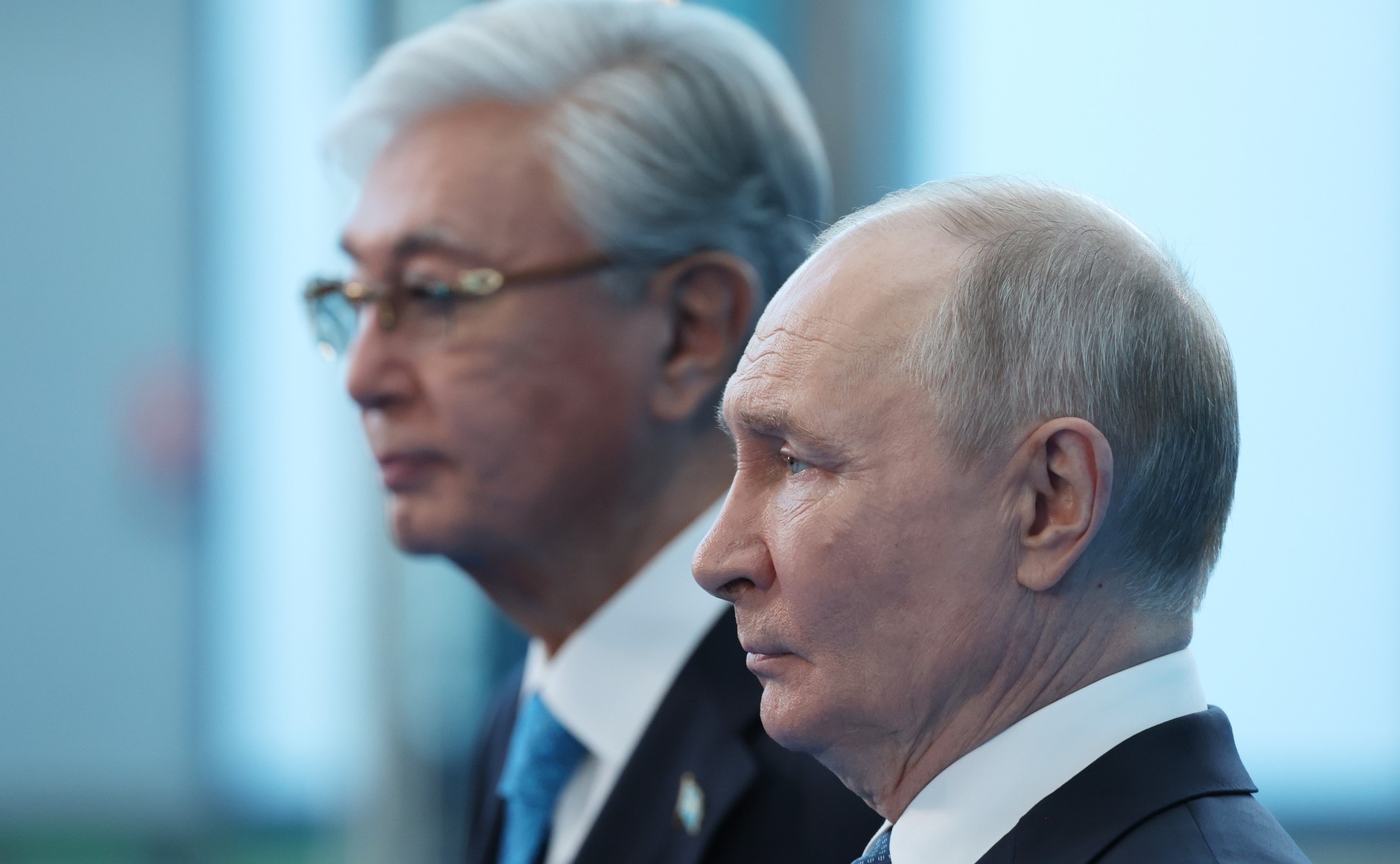
OMSK (Realist English). On July 25, on the sidelines of the 22nd Forum of Interregional Cooperation between Russia and Kazakhstan in Omsk, a bilateral meeting was held between the presidents of the two countries. Beyond economic cooperation, the central topic of the talks was the Ukrainian settlement.
Kazakh President Kassym-Jomart Tokayev put forward an initiative to return to the so‑called “Istanbul Formula 2.0” and consider the possibility of freezing the conflict.
“The Conflict Should Already Be Frozen”: Tokayev’s Proposal
During the meeting with Vladimir Putin, Tokayev stated that to resolve the situation in Ukraine, it would be possible to return to the formula of the Istanbul agreements reached in March 2022. These agreements envisaged a non‑aligned and nuclear‑free status for Ukraine, a renunciation of NATO membership, and the provision of security guarantees.
“Perhaps this conflict should already be frozen and we should return to the Istanbul Formula 2.0, since significant results were achieved there,” Tokayev was quoted as saying by Komsomolskaya Pravda.
The Kazakh president clarified that such a settlement would only be possible under the guarantees of the “great powers,” including Russia. “And then move toward the long‑awaited peace,” he added.
Tokayev also referred to the “Anchorage Agreements,” noting that Putin had shown “maximum diplomatic flexibility” at the meeting in Alaska. At the same time, the Kazakh leader categorically refused to act as a mediator: “I categorically refuse to be a mediator, because I know that Russia is a great country, and the Russian people are a great people.”
Putin’s Response: A Detailed Discussion Behind Closed Doors
Vladimir Putin did not give an immediate public assessment of Tokayev’s proposal but promised to inform his Kazakh counterpart in detail about the current situation in the special military operation zone.
“As for the Ukrainian direction, I will inform you in detail during our conversation,” the Russian president said.
Kremlin spokesman Dmitry Peskov later confirmed that Putin had thoroughly explained all aspects of the SMO to Tokayev. Peskov also reminded that the conditions for a cessation of hostilities had been set out by the Russian Foreign Ministry two years ago and remain “consistent and clear.”
Attacks on the CPC: A Blow to the Economies of Three Countries
One of the key topics of the talks was the recent attacks by the Armed Forces of Ukraine on the infrastructure of the Caspian Pipeline Consortium (CPC) in Novorossiysk.
As Peskov noted, these attacks effectively mean an assault not only on Russia but also on Kazakhstan and the United States, since American companies are also among the consortium’s shareholders.
The strikes on the CPC directly damage Kazakhstan’s economy, for which this route is a key export channel.
Economic Cooperation: Trade Turnover Is Growing
Beyond political issues, the presidents discussed a wide range of bilateral economic relations. Putin noted that trade turnover between the two countries in the first five months of 2026 grew by 4% and reached nearly $29 billion. Last year, the figure stood at $28 billion.
The Russian leader stressed that relations between the two countries are “strategic in nature not in words but in deeds.” He also said that 70 joint projects involving Russian business are being implemented in Kazakhstan’s economy, with a total value of $30 billion.
“In this sense, Russia is the largest investor in the Kazakh economy, and across very diverse areas: metallurgy, machine building, energy, and pharmaceuticals,” Putin stated.
Humanitarian Cooperation and a Symbolic Gesture
The Russian leader separately addressed the strengthening of cultural and humanitarian ties. Thousands of Kazakh citizens are studying in Russian universities. A branch of Kazakhstan’s state university has been opened in Omsk, and Russian students have been granted 100 state scholarships.
During the meeting, Tokayev presented Putin with a painting depicting the scholar Chokan Valikhanov and the writer Fyodor Dostoevsky. As the Russian president noted, Omsk is not just any place for Tokayev: it was here, after being seriously wounded in the winter of 1945, that his father was treated.
Tokayev’s proposal to return to the “Istanbul Formula 2.0” has become one of the most significant diplomatic signals in recent times. However, as practice has shown, Kyiv is not yet ready to freeze the conflict on the terms discussed in 2022. Putin, for his part, did not give public consent to the initiative, limiting himself to a promise of a detailed discussion behind closed doors.
Nevertheless, the very fact that the leader of a key Russian ally in Central Asia is raising the issue of the need to end the conflict indicates a growing demand for a peaceful settlement in the region.