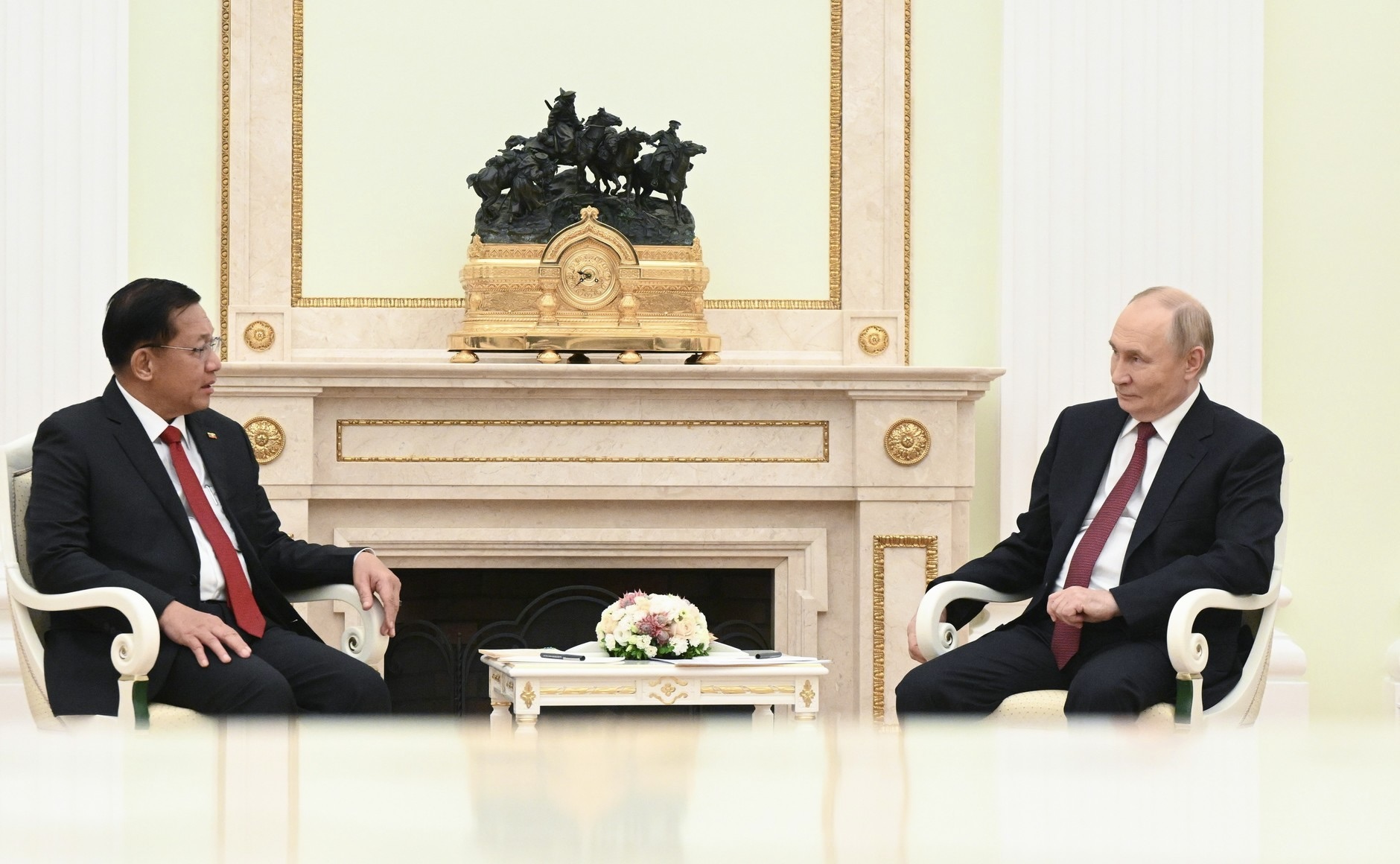
MOSCOW (Realist English). On 17 August, Myanmar’s President Min Aung Hlaing arrived in Russia on an official visit. This is his first foreign trip since taking office in April 2026 and his first visit to Moscow as head of state.
On 18 August, talks with Russian President Vladimir Putin are scheduled to take place at the Kremlin, following which several bilateral documents are expected to be signed.
First visit in a new capacity
Min Aung Hlaing, the former head of the military junta, became president of Myanmar in April 2026 following elections that Western countries and human rights organisations called “sham.” His current visit to Moscow is his first foreign trip as president.
The Myanmar leader departed from the capital Naypyidaw on the morning of 17 August, accompanied by other senior officials. In addition to the meeting with Putin, the visit programme includes talks with Russian Prime Minister Mikhail Mishustin and State Duma Chairman Vyacheslav Volodin, as well as participation in the Russian-Myanmar Economic Forum.
Agenda of the talks
According to a Kremlin statement, the leaders will discuss on 18 August “the prospects for deepening Russian-Myanmar cooperation in various spheres, as well as current issues on the international and regional agenda.”
Several bilateral documents are expected to be signed following the meeting.
Official Naypyidaw stated that the purpose of the visit is “to further strengthen the longstanding friendly and close relations between Myanmar and Russia and to enhance strategic cooperation,” particularly in the areas of security and the economy.
Allies in isolation
Russia was one of the few countries that supported the 2021 military coup in Myanmar, which overthrew the democratically elected government of Aung San Suu Kyi. Since then, Moscow and Naypyidaw have maintained close political and defence ties.
| Parameter | Details |
| Previous visits by Min Aung Hlaing to Russia | March 2025 (talks with Putin), May 2025 (Victory Day Parade), September 2025 (Nuclear Week forum) |
| Military cooperation | Five‑year military cooperation agreement signed in February 2026 |
| Use of Russian weaponry | Myanmar military uses Russian fighter jets against armed groups |
| Min Aung Hlaing’s visits since April 2026 | China, India, Thailand |
Myanmar’s military uses Russian aircraft to strike opposition armed groups and, according to observers, civilians – acts that some monitoring organisations classify as war crimes. Russia is also involved in energy and infrastructure projects in Myanmar.
International isolation and the search for allies
Since the 2021 coup, Myanmar has found itself in international isolation. The country has been stripped of representation in ASEAN and the UN, and its leaders are under Western sanctions. Since April 2026, Min Aung Hlaing has made several foreign trips – to China, India and Thailand – in an attempt to break the country out of isolation.
Russia remains one of the few key partners for Naypyidaw ready for full‑scale cooperation, despite criticism from the international community.
The visit to Moscow is a logical continuation of this course, as well as a demonstration that Myanmar continues to bet on a strategic alliance with Russia.
Expert opinion: ‘Moscow gains access to Southeast Asia’
A Southeast Asia expert and senior researcher at the Center for Asian Studies of IMEMO RAS told the press:
“For Min Aung Hlaing, this visit is a demonstration of legitimacy and an attempt to strengthen ties with a key ally. For Russia, it is an expansion of influence in the region and access to a strategic partner.
The international community continues to criticise both the regime in Myanmar and its ties with Moscow. The question is whether the alliance with Russia can bring Myanmar out of isolation – or whether the country will remain a ‘pariah,’ deepening its dependence on a limited circle of partners.”
Analysis: alliance against isolation
Min Aung Hlaing’s visit to Moscow is a logical continuation of Naypyidaw’s course towards a strategic alliance with Russia. For the Myanmar leader, it is an opportunity to demonstrate the legitimacy of his presidency and strengthen ties with a key ally.
Russia, for its part, is expanding its influence in Southeast Asia and gaining access to a partner in the region that shares its critical stance towards Western dominance.
However, serious challenges remain. Myanmar remains in international isolation, and its ties with Moscow only intensify criticism from the West and human rights organisations.
The question is whether the alliance with Russia and other allies can bring Myanmar out of isolation – or whether the country will remain a “pariah,” deepening its dependence on a limited circle of partners.