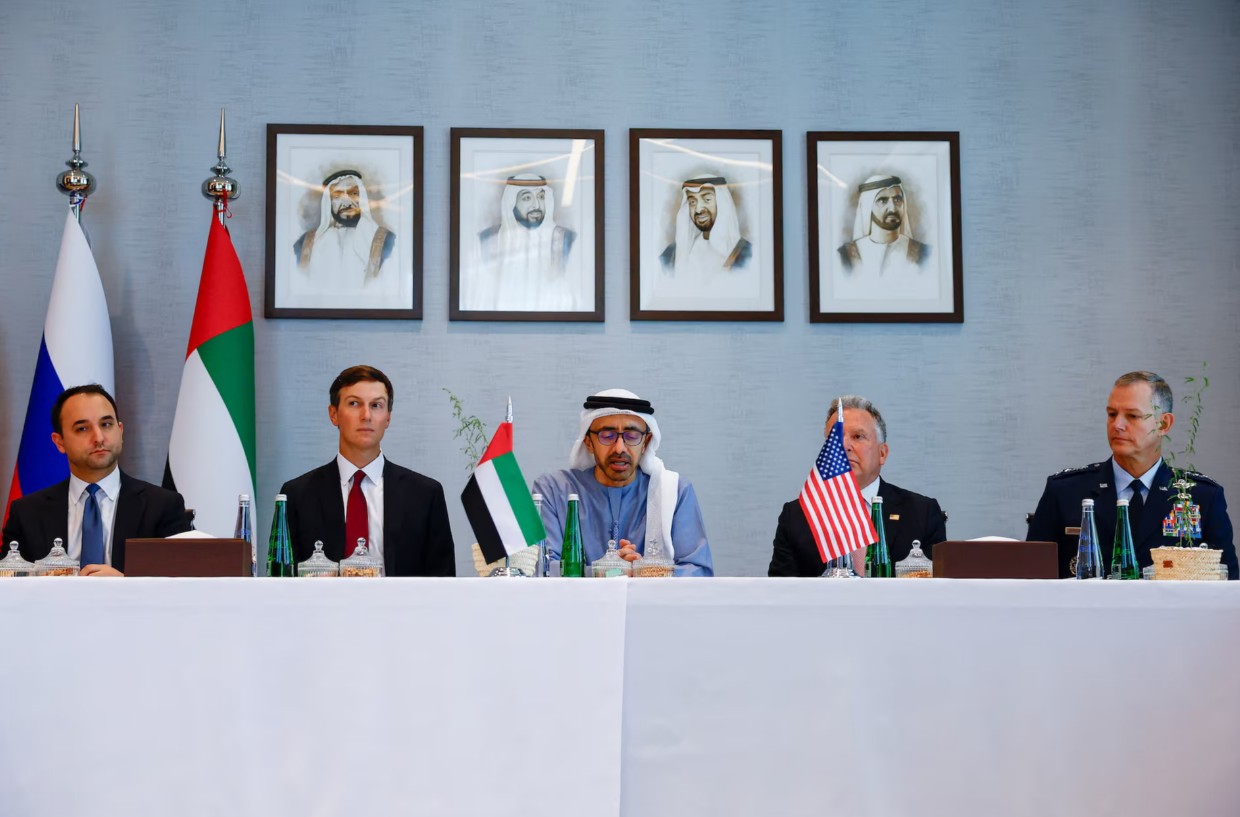
ABU DHABI (Realist English). The talks were announced on 2 November by US special envoy Steve Witkoff. Initially the meeting was planned as “work at the level of working groups,” but the composition of the delegations points to a more serious format: they include high-ranking representatives of military and intelligence agencies. The previous round of trilateral consultations was held in Geneva on 18 February 2026 and ended without result.
Composition of delegations and agenda
The Russian delegation, in addition to Medinsky, includes Deputy Foreign Ministers Sergei Ryabkov and Mikhail Galuzin, head of the Main Directorate of the General Staff Igor Kostyukov, deputy head of the Main Operational Directorate Yuri Zhigarlovsky and head of the Operational Information and International Relations Service of the FSB Alexei Komkov.
In total, the group has five delegation members and six experts. The Ukrainian delegation is headed by Rustem Umerov and also includes head of the presidential office Kyrylo Budanov, his first deputy Serhiy Kislytsia, head of the Servant of the People faction David Arakhamia and deputy head of the Main Intelligence Directorate Vadym Skibitsky.
According to statements by the parties, the agenda includes security guarantees, de-escalation in the Black Sea region and the energy sector, exchange of prisoners and preparation for a possible meeting of the leaders of the three countries. Witkoff also mentioned “post-conflict security arrangements” and humanitarian issues. The talks are being held behind closed doors; Putin’s press secretary Dmitry Peskov confirmed that “all details will be discussed behind closed doors.”
Positions of the parties
Publicly, the parties maintain their previous positions. Moscow insists on a settlement “on the basis of agreements reached in Istanbul, modalities discussed in Anchorage and, most importantly, the realities on the ground.”
Foreign Minister Sergei Lavrov stressed that Russia’s position “has not changed since the start of the special military operation.” Kyiv, in turn, continues to demand security guarantees that remain unacceptable to Moscow and insists on an energy truce and unblocking the Black Sea.
Role of Europe
Europe, concerned that Trump may strike a deal with Moscow on European security behind Kyiv’s back, sent its representatives to Abu Dhabi in a separate format.
Among them are French President’s diplomatic adviser Emmanuel Bonne, German Chancellor’s foreign policy adviser Günter Sautter, UK National Security Adviser Jonathan Powell and head of Ursula von der Leyen’s cabinet Björn Seibert. However, their formal participation in the trilateral process remains in question.
Assessments: “no breakthrough expected”
Sceptical expectations prevail. Ukrainian MP David Arakhamia said: “I don’t think there will be a breakthrough after such a long break. The very fact of resuming trilateral talks can be considered a success.” A senior Ukrainian official in Kyiv told AFP: “We have no special expectations.”
The resumption of talks in Abu Dhabi is more a diplomatic signal than a path to immediate settlement. For Washington, the meeting is important as a demonstration of foreign policy activity after the midterm elections; for Moscow, as a way to maintain dialogue with the US amid partial sanctions easing; for Kyiv, as an opportunity to retain Washington’s attention.
However, the fundamental gap remains: Russia does not renounce its territorial demands and “realities on the ground,” Ukraine is not ready for territorial concessions and demands security guarantees, and Europe remains in the position of an observer. The key question is whether this round will become the beginning of a substantive process or will remain a “synchronisation of watches” before a new round of escalation.