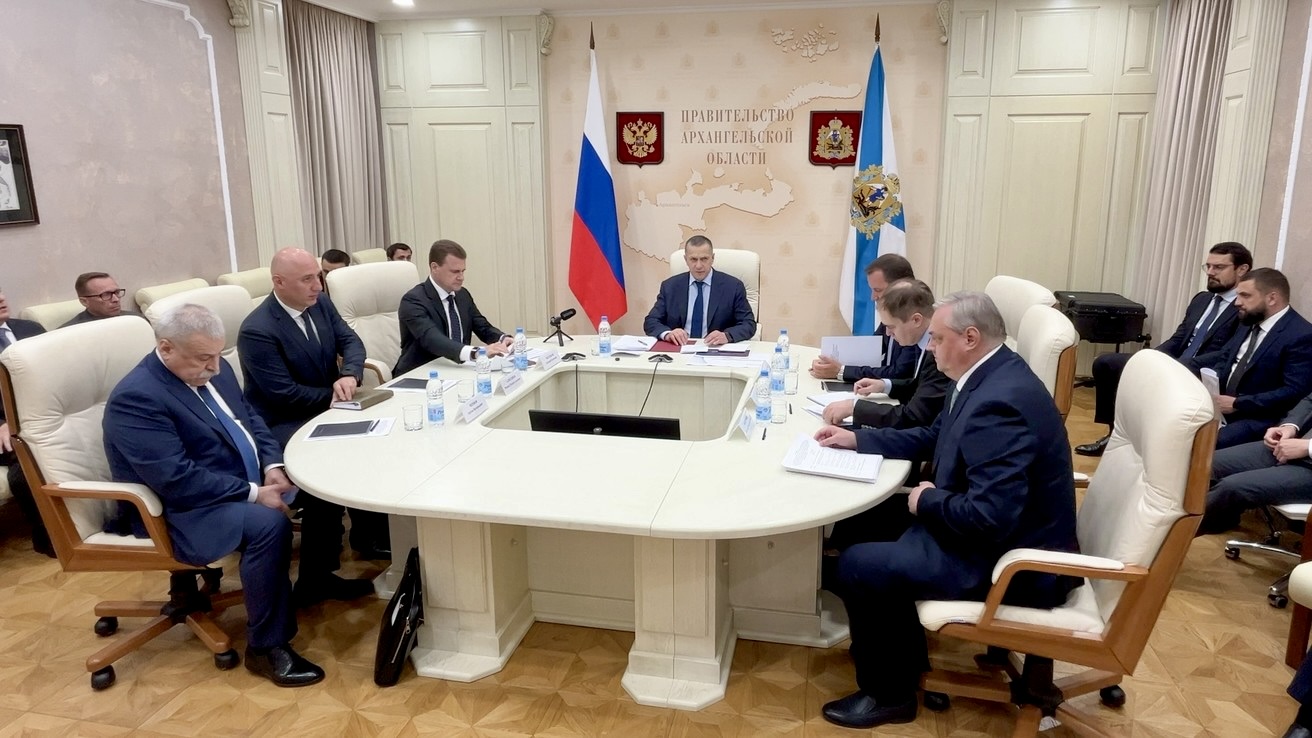
ARKHANGELSK (Realist English). Russia is embarking on the most ambitious infrastructure project in its modern history. On 28 July, in Arkhangelsk, a meeting chaired by Deputy Prime Minister – Presidential Plenipotentiary Envoy to the Far Eastern Federal District Yury Trutnev discussed the progress of the comprehensive project “Development of the Russian Arctic Zone and the Transarctic Transport Corridor”.
“The formation of the Transarctic Transport Corridor is a strategic task not only for the Russian Arctic zone, but for the entire global community,” Trutnev said as he opened the meeting.
The project is being implemented on the instructions of President Vladimir Putin, given following the International Arctic Forum “Arctic – Territory of Dialogue” in Murmansk.
32 trillion for Arctic development
The cost of the comprehensive plan for the Transarctic Transport Corridor (TTC) is estimated at 32 trillion roubles. Of this, 93% will come from extra‑budgetary sources – through private investors.
“We are assembling the complex structure of the TTC. This is a big job, and as a result we need to raise 32 trillion roubles,” the Deputy Prime Minister explained.
The work includes exploring mineral deposits, dredging riverbeds, building new railway sections, creating social infrastructure, housing, and possibly new settlements. The first phase is scheduled until 2030, the second until 2035.
From St. Petersburg to Vladivostok: what the corridor will look like
The Transarctic Transport Corridor is designed to unite the Northern Sea Route, inland waterways, seaports and land infrastructure into a single transport system. The new route will run from St. Petersburg via Murmansk to Vladivostok.
The corridor will connect the regions of Siberia, the Urals and the Far East with the ports of the Northern Sea Route and global trade routes, becoming an alternative to the Suez Canal. As Alexei Chekunkov, head of the Ministry for the Development of the Russian Far East and Arctic, noted, the project will ensure stable growth of international shipping regardless of geopolitical conditions.
Three stages until 2040
Rosatom Director General Alexei Likhachev presented a phased plan for the development of the TTC:
First stage (until 2030) – achieving cargo traffic on the Northern Sea Route of 70–109 million tons, driven by Russian projects and partners from China and India.
Second stage (2031–2035) – transition to year‑round navigation using a convoy principle and growth of cargo traffic to 150 million tons.
Third stage (2036–2040) – establishment of a sustainable year‑round shipping model with a systematic increase in cargo traffic eastward.
The “explosive” scenario envisages doubling the volume of traffic to 300 million tons as early as 2035. The project also includes the creation of a nuclear icebreaker fleet, cargo vessels and domestic dredging fleet.
Petropavlovsk‑Kamchatsky – a key port of the corridor
Following the meeting, the status of Petropavlovsk‑Kamchatsky as one of the key ports of the Transarctic Transport Corridor outside the Northern Sea Route was confirmed.
For the Kamchatka region, this means the development of port infrastructure, cabotage shipping, the northern supply system, and optimisation of fish product delivery to western regions. The region already has practical experience: refrigerated containers with fish were sent from Petropavlovsk‑Kamchatsky along subsidised Northern Sea Route voyages.
New strategy: Arctic GRP to double
The updated Strategy for the Development of the Russian Arctic Zone, submitted by the government to the Security Council last week, provides for:
- growth of the gross regional product (GRP) of the AZRF from 14 trillion roubles in 2026 to 28 trillion by 2035;
- the macroregion’s share of the country’s economy – from 7.1% in 2030 to 8.2% in 2035;
- creation of more than 55,000 new jobs;
- more than doubling average per capita income to 226,000 roubles per month.
The comprehensive project will become the main tool for implementing the updated strategy. As Trutnev emphasised, the project consists of four interconnected blocks – investment, logistics, infrastructure and social development of territories.
‘Stitching together’ the entire territory of Russia
“The work is huge, but it will help us ‘stitch together’ the entire territory of Russia and create new conditions for its economic development,” Trutnev said back in December 2025 at the first meeting on the TTC.
Specialists are now shaping the financial‑economic and organisational model of the project: identifying priority measures, working on port modernisation, shipping development, security infrastructure and conditions for year‑round navigation.
Following the meeting in Arkhangelsk, the Deputy Prime Minister instructed to ensure coordination of all activities in terms of timelines, financing and infrastructure support.
The Transarctic Transport Corridor will become the longest and most complex transport project in the world. And Russia intends to implement it in full.