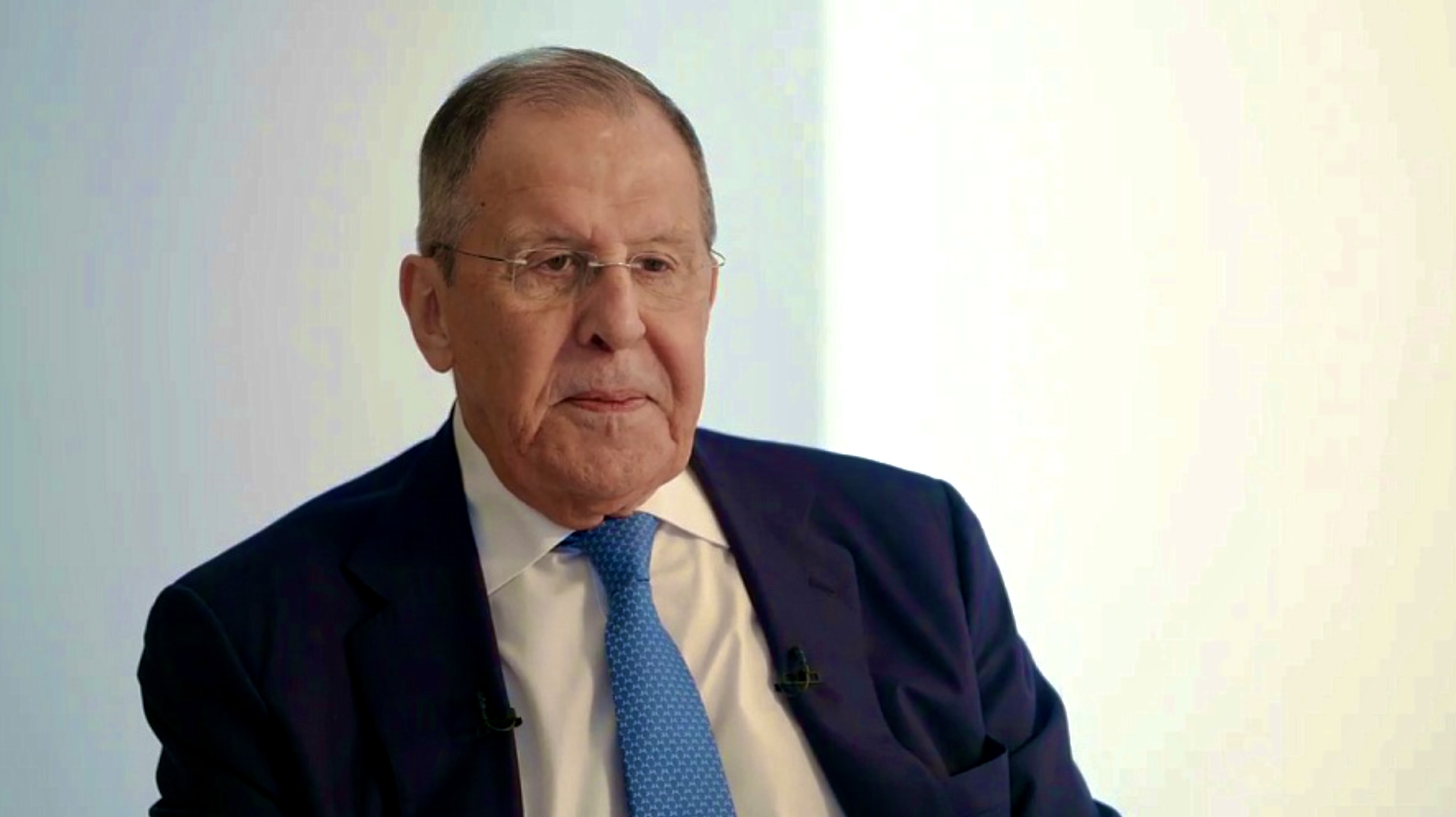
MOSCOW (Realist English). On July 29, Russian Foreign Minister Sergey Lavrov gave an extensive interview to the VGTRK television channel, covering a wide range of topics — from foreign policy priorities and sanctions pressure to personal memories, family roots, and his passion for rafting.
The Foreign Minister shared his reflections on “healthy anger” driving the country on the foreign policy front, on generational continuity, and on what the words “Motherland” and “Russia” mean to him.
Foreign Policy as an Extension of the Special Military Operation
Responding to a question about his inclusion in the federal “top five” of United Russia for the upcoming State Duma elections, Lavrov called it a decision by the country’s leadership during a difficult historical period.
“My presence in the ‘top five’ reflects the fact that the country is going through a very difficult period, which depends decisively on how we conduct the special military operation. Foreign policy and diplomacy are also called upon to play a major supporting role,” the minister said.
According to him, the West has “finally dropped all pretences” and moved to overtly support neo‑Nazis, whom it once saved after World War II.
“Today we are fighting the direct successors and descendants of those Nazis. German Chancellor Friedrich Merz openly says that they will be the leaders in Europe again. Nazism is being revived in plain sight,” Lavrov stressed.
“Healthy Anger” and Russian Identity
One of the key themes of the interview was the idea of “healthy anger” — a quality that, in the Foreign Minister’s view, is essential for achieving goals.
“Not to be annoyed, but to find healthy anger. And to decide with a ‘fighting spirit’ that we must do this — accelerate in technological breakthrough. And the same healthy anger is required of us on the external front,” Lavrov said.
He recalled President Vladimir Putin’s words that after the start of the special military operation, “things will never again be as they were before February 2022.” The minister noted that Russian society, despite unprecedented sanctions pressure — more than 35,000 restrictions — maintains cohesion and historical memory.
“The quality of our people is unique. We have a sense of historical continuity, of our national, multinational pride,” Lavrov added.
Family Roots and Character Formation
In the interview, Lavrov spoke in detail for the first time about his grandparents. His grandfather was the head of the railway station in Noginsk and was responsible for dispatching trains to the front during the Great Patriotic War. His grandmother worked as a senior nurse.
“Two of his brothers were at the front, and both returned. I loved them very much. They were truly my friends,” the minister shared.
He also admitted that his grandmother secretly baptised him behind his mother’s back — his mother was a communist — in a church on the banks of the Moscow River in Noginsk. The cross he received then has been preserved to this day.
Speaking about his character, Lavrov explained that a harsh word sometimes “slips out,” but his colleagues who claim he never allows himself such language at work are “liars.”
Rafting and “Instant Adrenaline”
The minister spoke about his long‑standing passion for rafting, which he has pursued since 1984–1985.
“We spent nearly 20 years on the Katun River. A fantastic region. Adrenaline hits instantly,” Lavrov shared, noting that his team never capsized, although colleagues on a second raft ended up in the water “a couple of times.”
He also confessed his love for the songs of Vladimir Vysotsky and Bulat Okudzhava, which he performs around campfires with a guitar.
When asked by the journalist about the possibility of recording his songs, Lavrov replied: “I’ll take advantage of your opportunities in the media space. Without any fees, if anyone is interested.”
Russia as a Civilisation
Responding to a question about national interests, Lavrov stressed that for Russia, it is important to remain an independent power and civilisation.
“Our national interests are that we should be an independent power, an independent civilisation. That our borders should be reliably secured. And that no one should even think of telling us how to arrange our lives inside Russia,” the minister said.
He also noted that Russia will cooperate on equal terms with new centres of power — China, India, and other BRICS countries — where decisions are made on the basis of consensus and mutual respect.
On the Future and Historical Mission
Lavrov expressed confidence that Russia is completing the work of its grandfathers and great‑grandfathers, who destroyed Nazism.
“We have no other option if we want to remain our Russian civilisation,” the minister stressed.
To the final question — what does the word “Motherland” mean to him? — Lavrov answered succinctly and profoundly: “Russia is life, and life is Russia.”