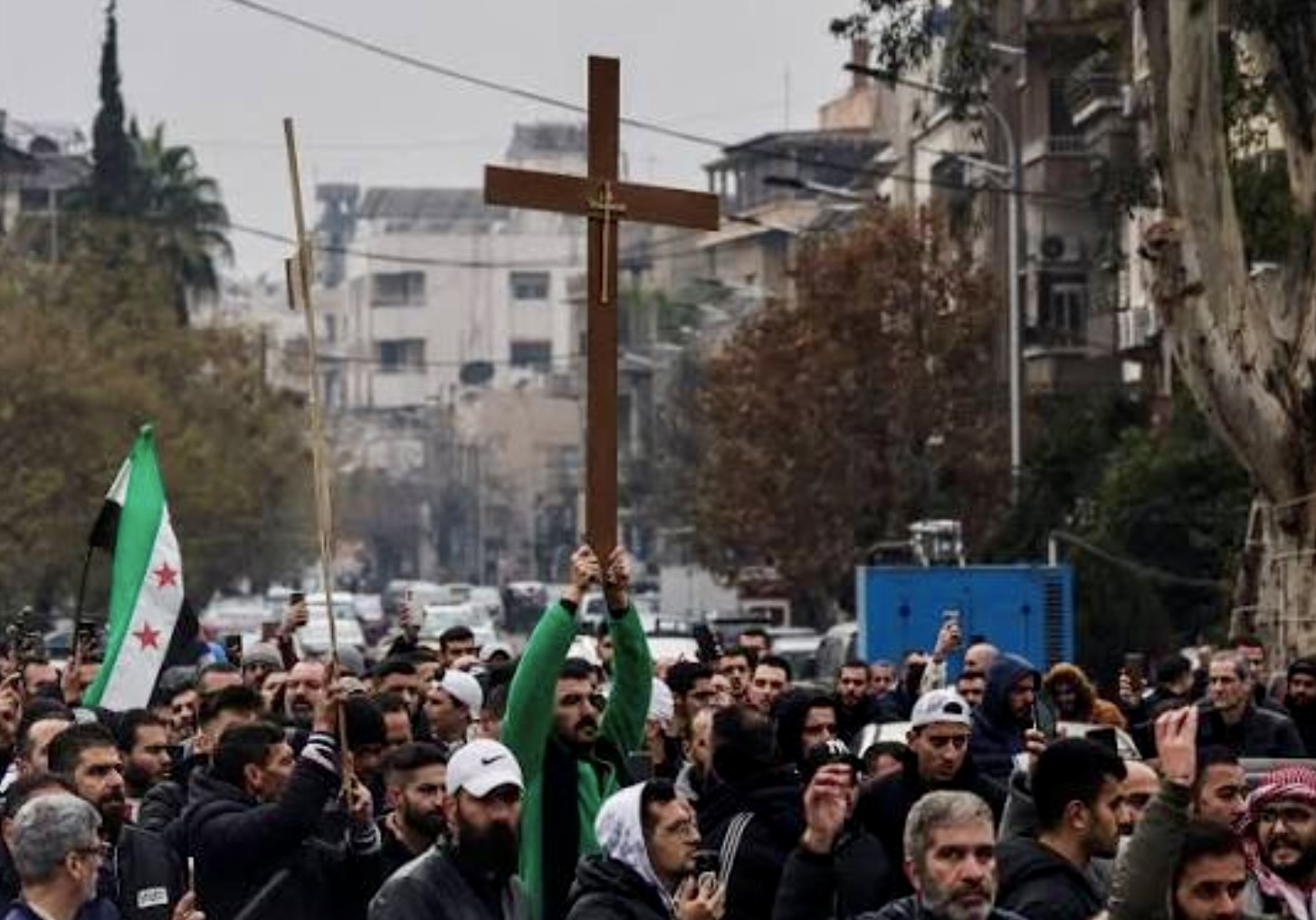
DAMASCUS (Realist English). Syria’s Christian communities, among the oldest in the world, are experiencing a catastrophic decline. Over 14 years of civil war, the number of Christians in the country has decreased by 80–90% — from 1.5–2.2 million to approximately 300,000–400,000. This is according to data from international organizations, including Open Doors, Aid to the Church in Need (ACN), and L’Œuvre d’Orient.
“More than half of those remaining are over 50, pointing to an ‘inverted’ age structure in which there are virtually no young people capable of or willing to stay in their homeland,” notes a November 2025 report by L’Œuvre d’Orient. According to Open Doors, as of early 2026, about 300,000 Christians remain in Syria — hundreds of thousands fewer than a decade ago.
Destroyed Churches: From 120 to 400
Estimates of the number of damaged Christian churches vary. According to the Syrian ambassador to Russia (2014), 98 churches were damaged or destroyed. Metropolitan Hilarion (Alfeyev) cited a figure of at least 120 churches requiring restoration.
Patriarch Kirill in 2024 spoke of 400 churches. Some estimates mention 82 completely destroyed churches. In Deir ez-Zor alone, all five city churches were either severely damaged or almost completely destroyed.
Sharp Rise in Persecution: From 18th to 6th Place
Following the fall of Bashar al-Assad in December 2024 and the rise to power of the terrorist group Hayat Tahrir al-Sham (HTS), which has roots in Al‑Qaeda (banned in Russia), violence against Christians sharply intensified.
According to Open Doors, during the reporting period from October 1, 2024, to September 30, 2025, at least 27 Christians were killed in Syria for their faith.
In 2025, Syria ranked 18th in Open Doors’ World Watch List, but in 2026 it rose to 6th place. This is the sharpest change in the ranking in the history of the list. The level of violence rose from 7.0 to 16.1 points. Syria moved from the “severe” to the “extreme” category.
Terrorist Attack at St. Elijah’s Church: 25 Dead
The main event that shook the Christian community was the terrorist attack on June 22, 2025, at the Greek Orthodox Church of St. Elijah (Mar Elias) in Damascus. A suicide bomber opened fire on parishioners during a Sunday service and then detonated an explosive device. At least 25 people were killed, and more than 60 were wounded. It was the first attack on a Christian community in Damascus since the massacre of 1860.
“We don’t feel safe here,” 23‑year‑old Anji Awabdeh, who was wounded in the attack, told the BBC. “I just want to leave this country. I have lived through crisis, war, mortar attacks. I never expected that something would happen to me inside a church.”
Intimidation and Coercion
In addition to armed attacks, Christians face systematic intimidation. According to Reverend Gary Stegg, executive director of Open Doors Canada, extremist groups are “trying to intimidate the 300,000 remaining Christians into converting to Islam.” Cars with loudspeakers drive through Christian neighborhoods of Damascus, urging residents to convert to Islam. Leaflets demanding payment of the jizya (poll tax) appear on church walls.
In Damascus and Aleppo, churches are under constant surveillance and face bureaucratic delays. In March 2025, the patriarchs of three Christian churches in Damascus issued a joint statement testifying to “massacres of innocent civilians.” On March 29, 2026, a meeting took place between the heads of Syria’s Christian churches and Patriarch John X of Antioch, during which they discussed the situation of Christians and the “need to curb the uncontrolled spread of weapons.”
Assessments by International Organizations
- Open Doors (WWL 2026): Syria rose from 18th to 6th place in the list of countries with the most severe situation for Christians. The level of persecution is assessed as “extreme.”
- USCIRF (US Commission on International Religious Freedom): The report notes that Syria’s transitional authorities “failed to protect freedom of religion,” and that both state and non‑state actors carried out extrajudicial executions of Alawites, Druze, Christians and other religious groups.
- L’Œuvre d’Orient (2025): Christian communities are “greatly diminished and extremely vulnerable.” At the same time, their important social role is highlighted: 57 church schools educate 30,000 children, and 4 Christian hospitals receive about 117,000 patients annually.
- European Parliament: Resolutions condemn attacks on Christians and call on Syrian authorities to ensure the protection of all ethnic and religious communities. MEPs express concern that attacks are carried out “with the connivance or even under the leadership of forces close to the Syrian regime.”
“We exist. We don’t want to die and be forgotten,” said a young medical student from Damascus in the L’Œuvre d’Orient report.
According to European Parliament experts, the share of Christians in Syria’s population has fallen from 10% in 2011 to 2–3% today. The constitutional declaration of March 2025 established rule based on Islamic law (Sharia). The question of whether Christian communities will be able to maintain their presence on the ancient Syrian land remains open.