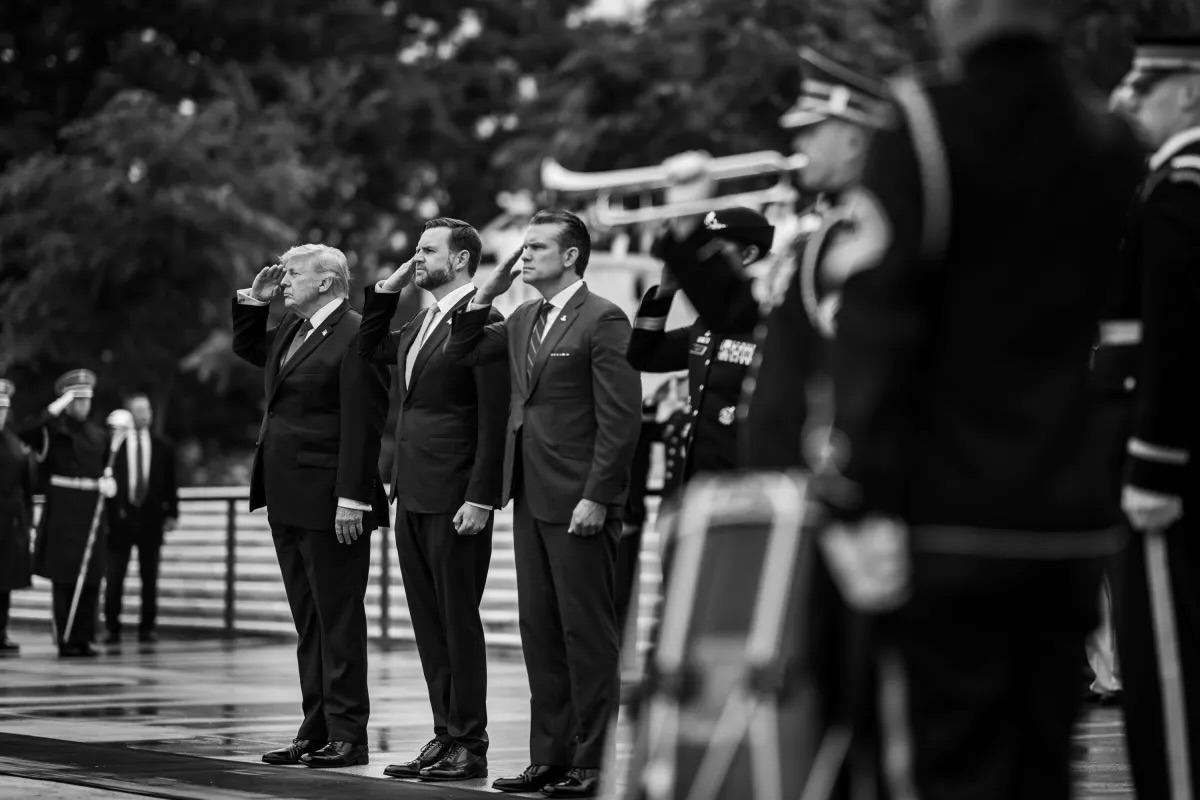
BRUSSELS (Realist English). US Defense Secretary Pete Hegseth, speaking at a meeting of NATO defence ministers in Brussels, announced the launch of a six‑month review of American military presence in Europe, threatening to cut funding for the alliance for countries that fail to meet defence spending commitments.
Hegseth’s address, in which he called NATO a “paper tiger” and a “one‑way street,” caused serious concern among European allies.
‘Real review’ with uncertain outcomes
Speaking to his counterparts at NATO headquarters, Hegseth said the review, which will last up to six months, is designed to “transform NATO back into a real military alliance focused on hard power and real deterrence.”
“This will be a real review,” he stressed. “It will be designed to move NATO rapidly and irreversibly toward Europe taking primary responsibility for Europe’s defence.” The Pentagon chief warned that the results of the review could vary by country: “This is a review that some countries will fail, while others will pass with flying colours.”
He did not specify whether the review would lead to a reduction of US troops in Europe.
‘Paper tiger’ and ‘free riders’
Hegseth lashed out at European members of the alliance, accusing them of insufficient defence spending and of limiting support for the US during the war with Iran. “For too long, NATO has been a paper tiger and a one‑way street. Enough,” he said.
The minister was particularly incensed by the refusal of some countries to grant US forces access to bases and overflight rights for operations against Iran. “These allies put American sons and daughters at risk by denying them predictable access, basing and overflight that should never have been questioned,” he said.
He also criticised European countries for focusing on “gender equality and climate change” at the expense of defence capability. “Instead of tanks, fighters and air defence systems, attention was focused on gender equality, climate change and defence savings,” he stated.
Financial leverage
Hegseth made US funding for NATO conditional on allies meeting defence spending commitments. He said the US contribution to the alliance’s operational costs, about $790 million in 2026, would “depend” on achieving spending targets. “Where other allies do not spend with urgency, our contributions will decrease,” he threatened.
The announcement came as the US has already reduced its commitments to the NATO Force Model. According to NATO Secretary‑General Mark Rutte, these changes took effect immediately.
NATO 3.0: a return to the Cold War?
Hegseth presented his review as part of a “NATO 3.0” concept, which would return the alliance to a Cold War‑era model. “NATO 2.0 was an era of distraction, de‑industrialisation and demilitarisation. It was an era of free‑riding, and they were lost years that we will not return to,” he said. He stressed that NATO’s founders, including President Dwight Eisenhower, “always expected” Europe to take the lead in its own defence.
NATO reaction and European responses
Secretary‑General Mark Rutte confirmed that the reduction in US participation in the alliance’s forces has already taken effect. However, he assured that in the event of a real conflict, “all allies, including the US, will do everything they can so that we can fight a war.”
Rutte also noted that European allies and Canada had already increased defence spending by $90 billion in 2025, almost 20% more than in 2024. Some countries, including Belgium, have already offered to make up for the reduction in US capabilities.
Nevertheless, Hegseth’s address — his first at a NATO meeting this year — left European allies with a sense of uncertainty ahead of the alliance’s summit in Ankara on July 7‑8.