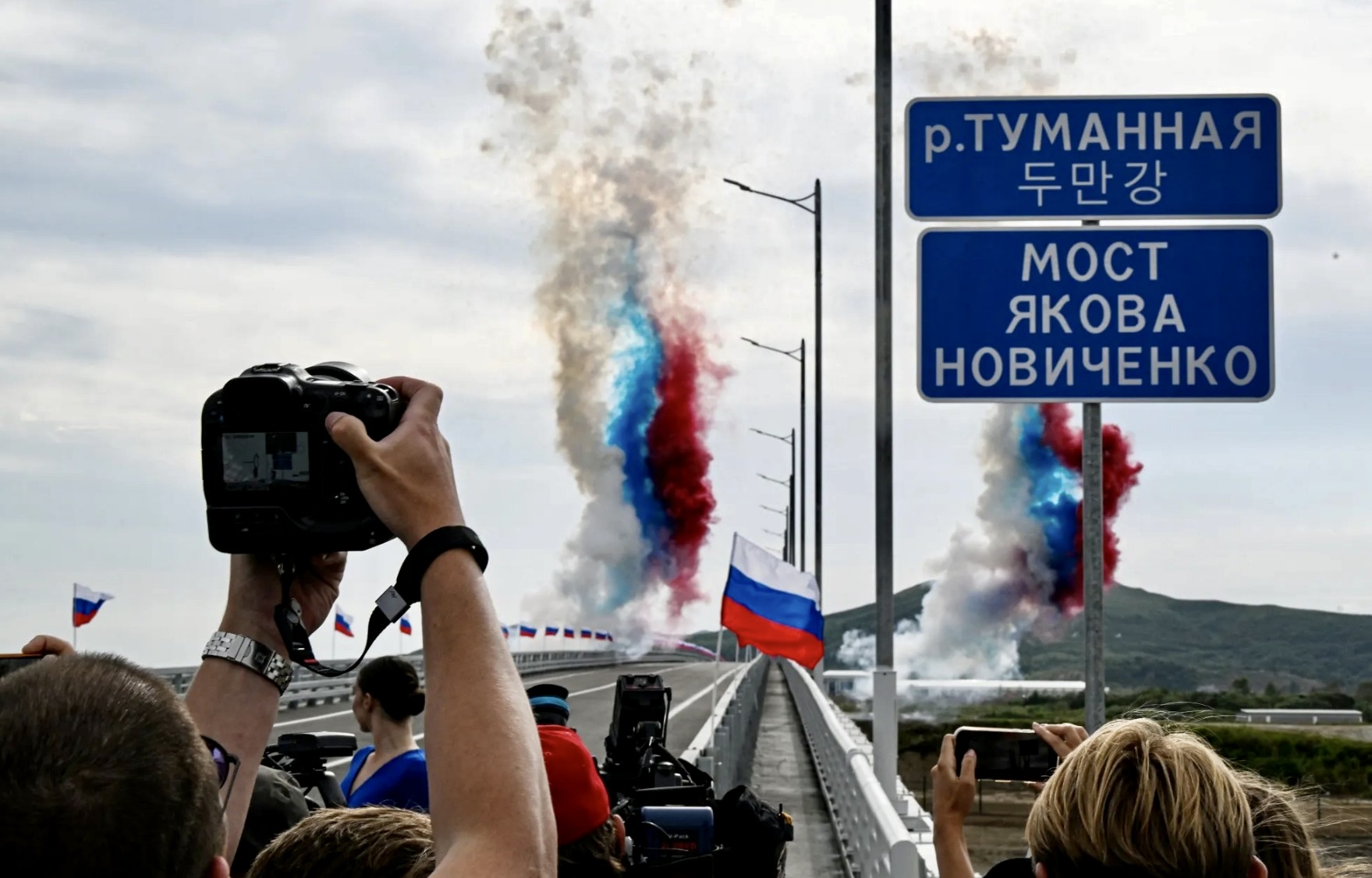
VLADIVOSTOK (Realist English). On September 7, Russia and North Korea opened the first road bridge in history connecting the two countries. The two‑lane crossing over the Tumen River, named after Soviet officer Yakov Novichenko, has become not only a transport link but a symbol of the rapidly deepening ties between Moscow and Pyongyang amid expanding military‑political cooperation.
The opening ceremony took place via video conference, attended by Russian Prime Minister Mikhail Mishustin and North Korean Cabinet Premier Pak Thae‑song.
A “Historic Event”: How the Bridge Was Opened
The ceremony was held on September 7 via video link. Russian Prime Minister Mikhail Mishustin and North Korean Cabinet Premier Pak Thae‑song participated on behalf of their respective countries. Construction began on April 30, 2025, and took about 16 months to complete.
Mishustin described the opening as a “historic event” and stressed that relations between Russia and North Korea are at an “unprecedentedly high level of comprehensive strategic partnership.”
According to him, the expansion of cross‑border transport infrastructure will create additional opportunities for trade, economic, scientific‑technological and cultural cooperation.
A Hero’s Name: Why the Bridge Was Named After Novichenko
The bridge was officially named after Yakov Novichenko — a Soviet Red Army officer and Hero of Labour of the DPRK. In March 1946, Novichenko threw himself on a grenade that had been tossed at North Korea’s founder Kim Il‑sung during a rally in Pyongyang, saving his life. Novichenko survived but was seriously wounded.
At the opening ceremony, a column of vehicles from the Russian side was led by a red “Zaporozhets” that once belonged to Novichenko — a symbolic gesture connecting history with the present.
Technical Specifications and Capacity
| Parameter | Value |
| Total bridge crossing length | ~4.7 km (including access roads) |
| Bridge itself | ~1 km |
| Russian side | 424 m |
| North Korean side | 581 m |
| Lanes | 2 (width — 7 m) |
| Daily capacity | up to 300 vehicles and ~2,325 people |
| Border crossing | “Khasan” (10 lanes) |
Until now, there was no road connection between the two countries; only a railway route existed via the “Friendship Bridge.” The new crossing will enable year‑round motor vehicle traffic.
The access road to the bridge connects to the federal Ussuri highway, which is part of the “West‑East” international transport corridor, providing continuous high‑speed traffic from St Petersburg to Vladivostok.
A Bridge as a Symbol of Rapprochement
The agreement to build the bridge was signed in 2024 in the presence of Vladimir Putin and Kim Jong‑un. At the same time, Russia and North Korea signed a treaty on comprehensive strategic partnership, reflecting a new level of bilateral relations.
As Bloomberg notes, the bridge’s opening is “a new sign of deepening ties between Moscow and Kim Jong‑un’s regime.” Reuters calls it “a symbol of expanding ties.” Bilateral cooperation has significantly strengthened since the start of the war in Ukraine in 2022, when Pyongyang sent thousands of its troops to support Russia.
A New Chapter, But Unanswered Questions
The opening of the road bridge over the Tumen River is more than an infrastructure project — it is a significant geopolitical signal. For the first time in history, Russia and North Korea have a direct land road connection, which will substantially reduce logistics costs and simplify freight traffic.
For Moscow, this project is part of a strategy to expand logistics capacity in the Far East. For Pyongyang, it offers a chance to reduce dependence on China in transport matters and strengthen ties with its only major ally.
Yet the key question remains: how quickly will the new crossing be integrated into the logistics systems of both countries, and will it — alongside the Friendship Bridge — become a conduit for military and commercial cargo? The answers will become clearer in the coming months as the crossing’s traffic load becomes apparent.